

By Sergi Formentin
Photographs: © IndigoBe Madagascar, Sylvia Pallarès, Carlos M.Martín, Dennis Vdw
The dreams of always are now possible realities. Among the images that every traveler remembers having seen at some time on the island of Madagascar, the magnificent Tsingy de Bemaraha, unique limestone formations declared a World Heritage Site by UNESCO, stand out.
Sliding through its rocky galleries and traversing its endless natural labyrinths will become an unforgettable experience for all travelers.
The far west of Madagascar allows us to alternate the exploration on foot of the Tsingy of Bemaraha with the calm descent by canoe of the calm waters of the largest river of the island, the Tsiribihina.
TSIRIBIHINA RIVER DESCENT
The descent by traditional canoe through the meanders and gorges of the Tsiribihina River is an experience that will not leave indifferent those travelers who love ecotourism and adventure.
During 3 days we will navigate the calm waters of the largest river in Western Madagascar in traditional canoes and accompanied by paddlers of the Sakalava Menabe ethnic group, with whom we will share their culture and experiences and discover the native fauna and flora of the region, as well as their interesting traditional villages. They will be quiet stages, with starry nights of camping; days of much calm navigation, of contemplative life on board the canoe, of hours of reflection, of animated chatting around a campfire and of relaxing hours and hours of observation of nature, the local ethnic groups and the impressive landscapes of the river course.

We will descend through the river until we arrive at the end of the third day, at its mouth, in the town of Belo sur Tsiribihina.
During our canoeing adventure we will be able to observe several species of aquatic birds, such as the kingfisher, the Malagasy coucal, the ardea cinerea, the ardeola idea and the cua petirrojo. In addition, eventually we can also observe golden eagles, hawks and kestrels.
Among the reptiles that can be observed in this region are several species of chameleons(Furcifer and Brookesia), as well as snakes(boa madagascarensis) and Nile crocodiles, a non-endemic species introduced to the island and which has reproduced rapidly in the large rivers and lagoons of western Madagascar.
The mammals deserve a special mention, among which the lemurs of various species stand out, especially two types of Sifaka(Propithecus Verreuxi and Propithecus Decken’s).

The days of navigation in the canoes are quite long (from sunrise to sunset, although we stop for technical stops, eventual purchases of fish that our cooks will prepare masterfully for lunch or dinner, eventual visits, as well as meals) and many hours of relaxation are spent lying in the canoe, contemplating the landscape, photographing, listening to music, reading and feeling and enjoying the sounds and silences of the river. At night, the camp fires, the celestial vault and the anecdotes of our guides, as well as the pleasant conversations of the travelers always preside over all the evenings.
On the second day we will sail along a wider branch of the river, accessible to all types of boats, and we will reach the fantastic waterfall of Anosin’Ampela, where we can take a refreshing swim and have lunch in the shade of its trees.
During this day the landscape will change quite a lot and we will sail sometimes next to small tobacco fields, finally coming out to the widest stretch of the river where motor navigation is unfortunately allowed and where we will cross the first barges and ferries of our adventure.
A journey of sensations, in which time stands still and during which we will enjoy unforgettable landscapes. These will be intense days, dedicated to descend the largest river in Western Madagascar in a traditional way and in the company of canoeists and fishermen of the Sakalava-Menabe ethnic group. An unforgettable experience.
TSINGY OF BEMARAHA
From Belo, the dusty and wild tracks of Western Madagascar will take us in 4×4 vehicles to the Tsingy de Bemaraha National Park, declared a World Heritage Site by UNESCO and one of the most visited spots on the island of Madagascar.

But, even though it is a trekking of a few kilometers, it is not a trekking for everyone.
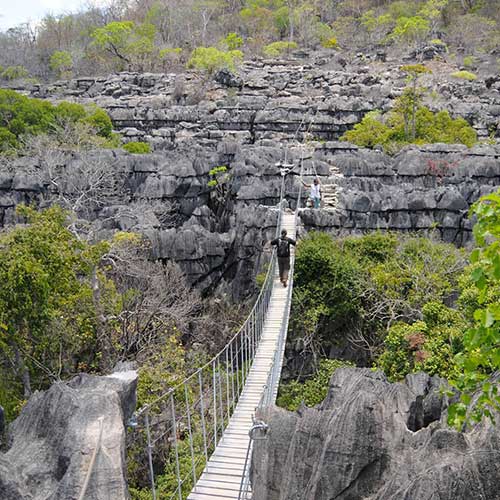
Although the visit to the Great Tsingy does not involve difficult ascents or steep slopes, it is forbidden to people who suffer from vertigo or who suffer from obesity. Any traveler in normal physical shape and without fear of heights can make the trekking of the great Tsingy of Bemaraha, which is developed through a simple via ferrata, using harnesses for the safety of visitors. You ascend and descend these magnificent limestone formations(paleokarts, ancient seabeds, unique in the world and that the different movements of immersion and emersion occurred 150 million years ago in the west of the island have led) across suspension bridges, down metal ladders and narrow gorges in a sort of stone mazes that will make us imagine that we have entered an impossible black hole that has led us to the very center of the Earth and appeared by magic in a lost world.
Find out how the Tsingys were formed HERE
TREKKING IN THE TSINGY OF BEMARAHA
Small Tsingy and Manambolo River Gorges, Tantely – SIMPLE TREKKING
This walk on foot begins with a pleasant one-hour canoe trip, during which you will visit two caves and observe the gorges of the Manambolo River. After the navigation you enter on foot in the Small Tsingy, to walk for an hour or hour and a half of duration in these labyrinths of limestone, which serve as training for the next day, to attack the trekking to the Great Tsingy of Bemaraha. This circuit in the Small Tsingy is accessible to all people, except for travelers suffering from obesity problems, since it is necessary to cross some narrow twists and turns in the rock.

Great Tsingy of Bemaraha, Andamozavaky -TREKKING MEDIUM
To make this trekking you have to drive 18 kilometers of track in 4×4 to reach the entrance of the Great Tsingy. It is a pedestrian circuit of about 4 hours (maximum) of duration, and in which you ascend (through via ferrata) to the large platforms from where you can see the top of the Tsingy de Bemaraha. You will also cross 2 spectacular suspension bridges, one of them located at 60m high and you will observe one of the most impressive landscapes of the island of Madagascar.

Great Tsingy of Bemaraha, Ranotsara – MEDIUM TREKKING
This circuit (maximum 3 hours) is very similar to the previous one, although it is less visited and somewhat shorter in distance. It also ascends by a via ferrata, crosses a suspension bridge located at 70m high and spectacular views from the top of the Tsingy. This circuit can be combined with the previous one in a full day of trekking. You can join both areas through spectacular caves (1 hour long, forbidden to people with claustrophobia, trekking with difficult sections), or through the savannah (simple hiking), or simply with a 15-minute transfer in 4×4 (the best option if you do not have much time between the two circuits).
Tips on Tsingy
Accessible from June to October, it should be noted that in the Tsingy of Bemaraha one of the biggest problems for travelers is the sweltering heat (very pronounced during the month of October) as well as the harshness of the sun’s rays. It is advisable to carry enough water and to protect your skin and head. It is also advisable, at the discretion of the travelers, to wear simple sport or climbing gloves because in some passages of the Great Tsingy you have to hold on to the sharp limestone points and the use of these gloves avoids small scratches on the hands. Walking sticks or poles should be avoided in the Great Tsingy, as well as any unnecessary weight or load. We must have our hands free and go as light as possible to access the summits of the Tsingy through the via ferrata, suspension bridges and metal ladders (firemen type).
Sources: IndigoBe Magazine. © All rights reserved
Do you want to travel to the Tsingys of Bemaraha? For more information click HERE